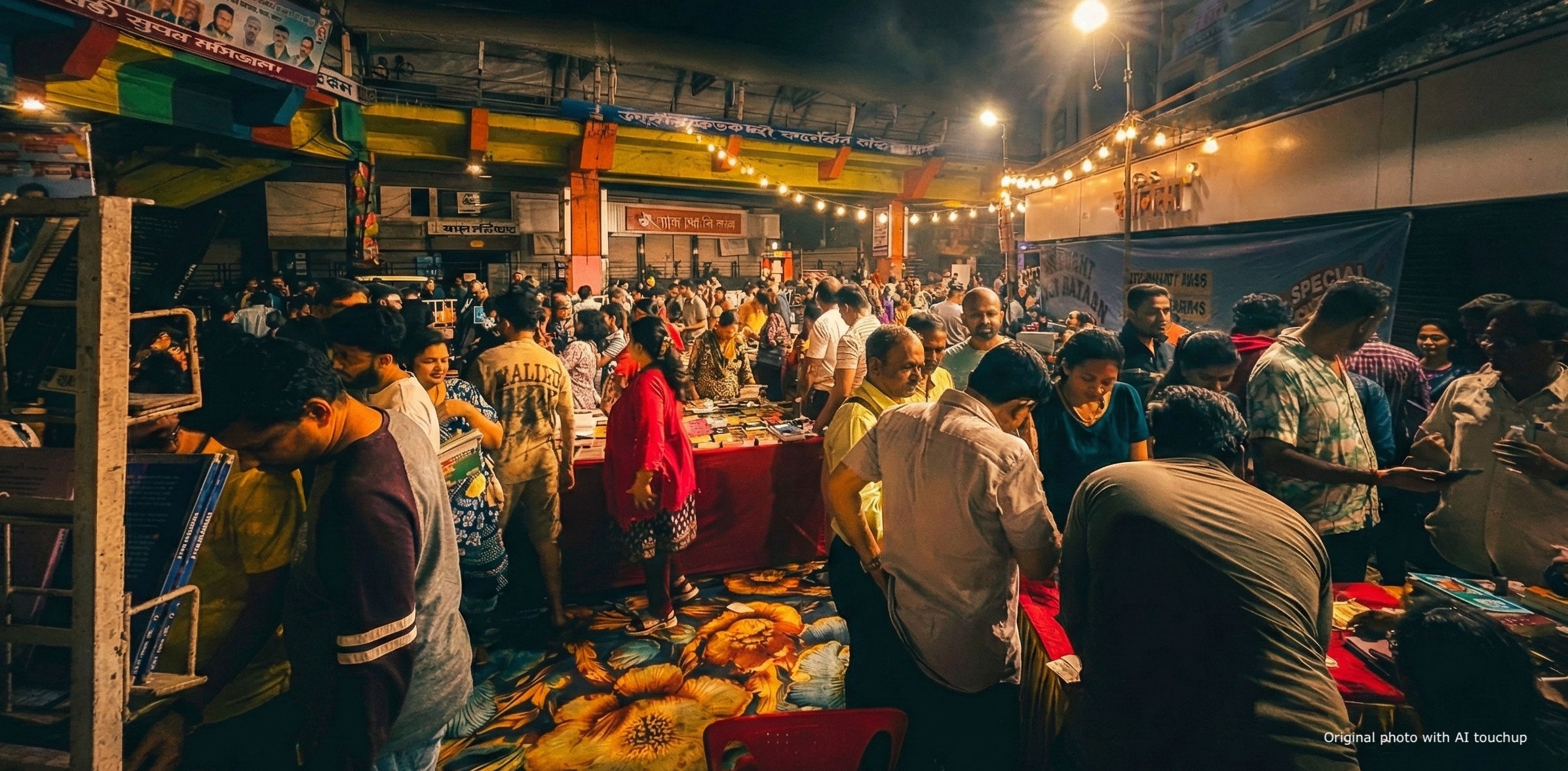
Night Exhibition of Books
When the World Sleeps, Stories Awaken
Ratri Book Bazaar
उसने उसे हाथ में लिया, आगे-पीछे पलटकर देखा, कुछ पन्ने उलटे और चलता बना। उसने (किताब ने) एक लंबी सांस ली यह सोचकर कि वो बिना सोचे चला गया — बिना यह जाने कि लेखक ने हजारों घंटे उसकी रचना में लगाए थे। ऐसी आहों से भरी पड़ी थी वो किताबों की बाज़ार। पर आज कुछ अलग ही हुआ — वो लौटा, और उसे साथ ले गया। और वो आह कृतज्ञता में बदल गई। बाकी सभी किताबें भी खुश थीं उसे जाते देखकर — कि चलो, कोई तो है कद्रदान, और हमारी बारी भी आएगी, आज नहीं तो कभी। और क्रांति की नींव रखी गई।
Translation
He picked it up in his hands, looked at it from front to back, flipped through a few pages, and started to leave. It heaved a sigh, thinking that he was leaving without considering the thousands of hours the author had spent on its creation. The book market was full of such sighs. But today something different happened—he came back and took it with him, and the sigh transformed into gratitude. All the other books were also happy seeing it go, thinking, “Well, at least there’s someone who appreciates, and our turn will come too, if not today then someday.” And the seeds of revolution were sown.
We have heard the concept of night markets for food, but recently I witnessed a different experience. I got a chance to be part of attending a night exhibition cum sales of books at Dombivli, a town on the west coast of India. It started on 31st January 2026 and the closing was in the early morning of 6am on 1st February 2026. In many cities of Gujarat, I have heard of and had the chance to visit night markets for food. I also witnessed the early morning open library (Navjivan Reading Club) at the garden of Navjivan Trust, Ahmedabad, where books are kept on tables and any person can come and read them.
However, this was a first unique experience of visiting a night book exhibition.
It was organized by Pai’s Friends Library, which has been running a book club and library in the town for a long time - I have witnessed their service for the last 21 years. In the era of eBooks and cost-effective alternative e-commerce book platforms, running this kind of service cannot happen without passion.
But the passion for running a library without like-minded people as an audience makes no sense. Generally, we see no or low footfall at book exhibitions, at least because people are more inclined towards other interesting avenues like mobiles and televisions. Also, with attention spans reducing consistently, having a reading habit is possible only if a person is a die-hard fan of books or has exams. Credit goes to the Marathi (Maharashtrian) people of the town, who came in large numbers to experience and buy the books. Without such people, the library would not have survived either. The idea itself was great, and people coming to it in good numbers showed they reciprocated well.
It was arranged in an open area but cornered by barricades. The collections were mainly in two languages - English and Marathi. You could read and decide. The genres were kept mixed across the tables.
Some of the parameters to measure the health of a society can be attributed to how many hospitals, orphanages, bookstores, and libraries it has. More hospitals suggest bad eating habits, more orphanages indicate inhumane mentality, while having more bookstores and libraries indicates hungry minds.
Thus said Dinesh Gajjar
Published at 17:40 pm, Feb 1st 2026 from Home, Sarvodaya Anand