The Freedom We Secretly Fear
an interesting perspective why we behave the way we behave?
Gunvant Shah is a famous writer of the Gujarati language. He has made a great contribution to the Gujarati language and literature. There is hardly any Gujarati reader who does not know his name. His writings on various subjects in simple and easy language are worth reading. His autobiographies are also of a distinct style, reflecting an understanding devoid of the “I” (ego). His thoughts on religion and spirituality are noble and inspiring. He had decided in his life that when he turned 50, he would leave whatever position or job he was doing and pursue his favorite work—“writing.” Today he is over 85 years old, and thirty-five years ago, he left his job as a college professor. At that time, he was offered a position up to that of a college dean, but he remained firm in his decision. As a result of that steadfastness, Gujarati literature received fine essays and books. When he announced this decision, that event certainly must not have been easy.
Amrutlal Vegad completed his studies at Shantiniketan and became an art professor in a city in Madhya Pradesh. He constantly felt that life shouldn’t just be about working as a professor. In his later years, he started a circumambulation (parikrama) of the Narmada River on foot. Whenever he got vacation, he would start the parikrama from one place and resume the next year from where he had finished. In this way, he completed a circumambulation of approximately 2,600 kilometers on his own terms. What was written as memories of that experience was published under the name “Saundaryani Nadi Narmada” (Narmada, the River of Beauty). It was translated into several languages. For this contribution, he was honored with the Sahitya Akademi Award in 2004. He undertook his last pilgrimage on foot at the age of 71. He performed this parikrama many times, doing it differently from the so-called traditional rules of parikrama. Many might have said that a parikrama shouldn’t be done this way and that spiritual merit (punya) wouldn’t be gained. But what he gained, and the experience others had through him, was perhaps greater than merit itself.
If you look around, you will find many (countless) such examples—from the present and from the past—which, from society’s perspective, might not seem practical, might look like crazy decisions, or might seem foolish; yet humans have taken such decisions over time. There are many examples of individuals who managed to hold on with a firm mind even in terrible circumstances. If you ever find the time, the book “Man’s Search for Meaning” is worth reading. It is a prime example of how a human being can endure through immense suffering.
If you ask almost any human being on Earth, the answer will mostly be that if they had their way, they would do what they love. Most people in the world do not want to do a job. No matter what kind it is or what position it holds, they do not like it. A routine has to be followed for 35–40 years, in which at least 10–12 hours of their day are spent away from loved ones, following a routine whether they like it or not. This applies not just to jobs, but to business as well. Sitting at a shop, unable to leave the counter, 16 hours of the day get consumed there. Eventually, life becomes such that if one does not follow that kind of routine, restlessness sets in, and it feels as though a crime has been committed.
So why does a human being constantly want to follow a routine, a pattern—continuing to do what they do not like? They want to live. They watch many reels, videos, read, and constantly wish to go to a place and a time where they can find peace, engage in activities they enjoy, and rest. If people are asked, most will say they want to do something else, but they have to do this—it is a compulsion, a responsibility. This word “responsibility” may seem small, but it has consumed the precious years of many a person’s life.
Many reasons can be given for behaving this way, but at its root, one major reason is that since birth, a human being has been conditioned—knowingly or unknowingly—in such a way that if they step out of a pattern, the system will try to stop them from doing so. Or, most importantly, their beliefs, intellectual capacity, perspective, and upbringing themselves prevent them from doing so. Society and external factors come later.
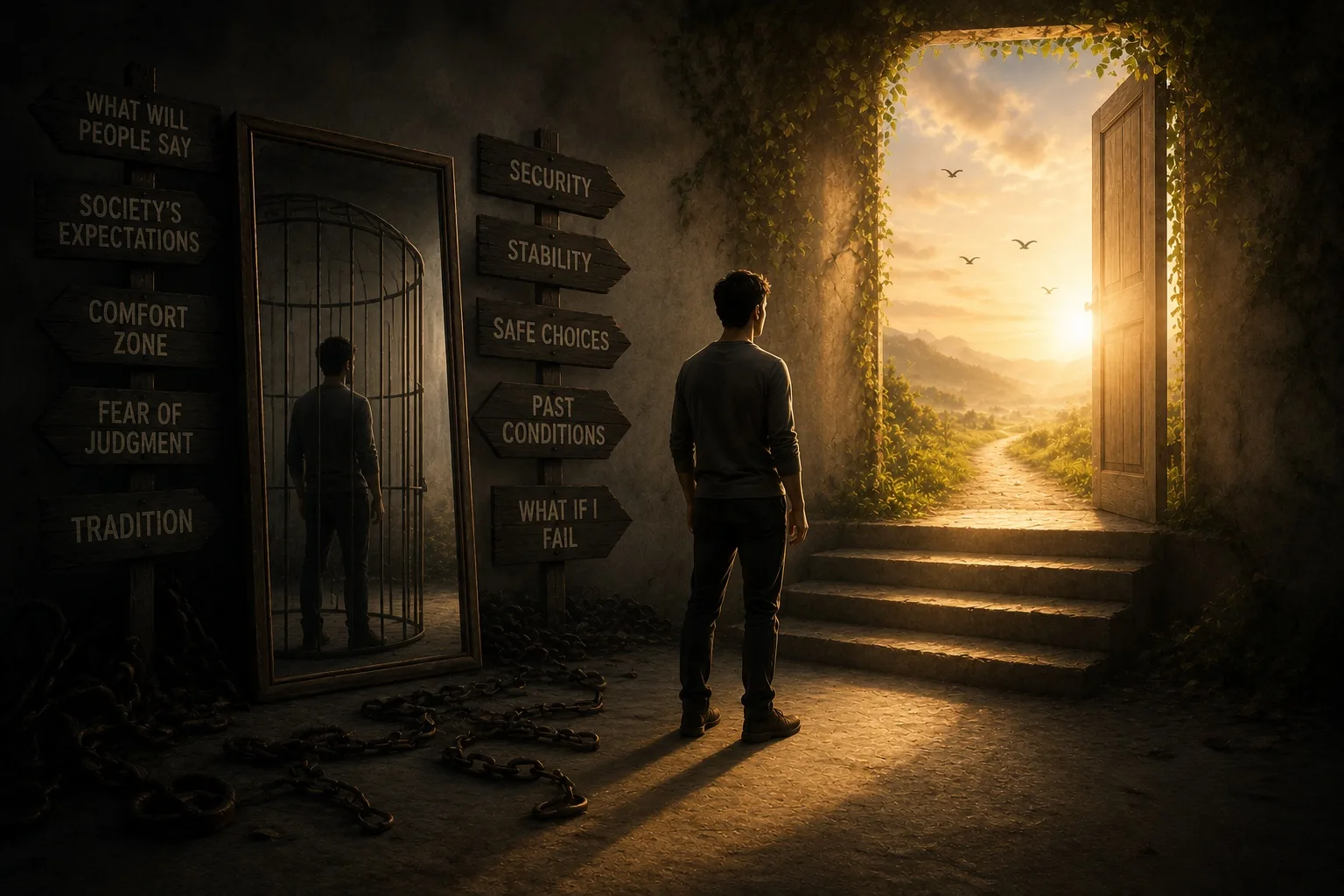
And this is not just with one person; this has been happening continuously ever since social life was created. In a way, a “fear of freedom” was subtly instilled. Humans began to feel that if they stayed outside a practice or predefined rules, they wouldn’t remain relevant in life and society. And the fear of the future—“what will happen next?”—such factors were continuously taught from birth. This is not about any single country or society. At any point in time, there are instances where society or a nation has put people to death for their distinct thoughts or actions. “Giordano Bruno” was one such name who, in the year 1600 AD, was burned alive in broad daylight by the authorities simply because he supported scientific research stating that the universe is infinite.
So this “fear of freedom” has been subtly programmed into human beings, and a subconscious fear has been instilled that along with freedom come options and choices, requiring countless decisions at every step. One mistake can ruin a person and push them into darkness. This fear has taken such deep root in humans that on their way to work from home, they forget to look at the flying birds, forget to hear their chirping, and forget to observe the joyful events occurring every moment in nature.
To emerge from this, the beginning requires consciously and witness-like observing these limitations; such a perspective needs to be cultivated. Decisions, choices, or options will come later. Awareness itself will lead toward freedom.
Essence
Awareness itself is the first doorway to freedom.
The moment we question our own beliefs, the journey of making true choices begins.
a Gem of Wisdom
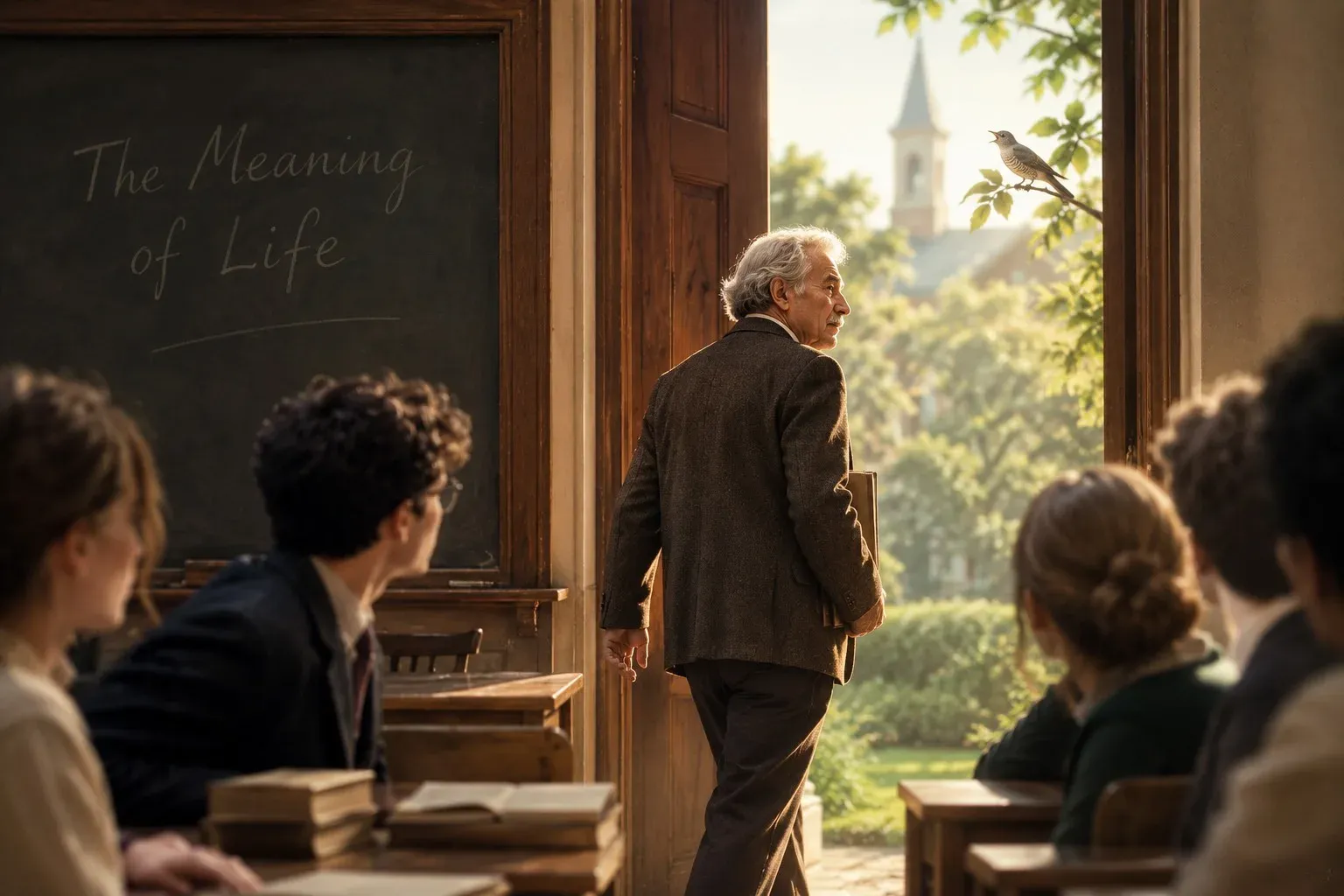
Once, George Santayana was delivering a lecture in a classroom at Harvard. Suddenly, he heard the call of a cuckoo. When he heard that call again, he stopped mid-sentence in what he was teaching and told the students, “Spring is calling me, I must go.” Leaving the lecture incomplete, he walked out. People saw him leaving the classroom for the last time, and after that, no one ever saw him teaching again.
Thus said Dinesh Gajjar
Published at 01:33 am, July 27th 2026 from Home, Sarvodaya Anand