What Words Cannot Hold
Sane Guruji was right
Sane Guruji wrote an entire book, Shyamchi Aai (Shyam’s Mother), celebrating the greatness of a mother, and yet he said that he could not do complete justice to her. There is a Sanskrit verse that says, “Putra kuputra bhavati, mata kumata na bhavati” — a son may turn out to be a bad son, but a mother can never be a bad mother. Even in incidents where a mother is held responsible, her intention, more often than not, is to give her child a better life. In the Ramayana too, while ordinary reasoning may lead us to blame Kaikeyi, we know that her intention was to secure the throne for her son. That is a different matter altogether, that her ability to think was confined within a limited circle of understanding.
Whatever the case may be, what I wish to write here today is an incident from my own life.
It was around 1984, and the city was Nashik. I must have been seven or eight years old. We lived in Indira Nagar, where people lived in independent bungalows, open on all four sides. These were not large bungalows — perhaps a single room with a kitchen, or a small one-bedroom house — but the rooms, kitchen, veranda and front porch were spacious. There were about eight of us living under one roof. It was rented house. We did not have a television at the time, and there were few sources of entertainment. Annual programmes were held at an open-air theatre in Indira Nagar, where people from the society participated. On one such occasion, my mother enrolled me to perform a children’s poem, for which I was supposed to make a few simple dance movements. She was the one who taught me those movements.
My mother herself was an artist and a good dancer. Many of her qualities found their way into my elder brother and sister. When she was young, she participated in several cultural programmes at her parental home in Jamnagar. Whether it was dancing, painting, rangoli, or anything else that offered an opportunity for creative expression, she would participate in some form or another and deliver an outstanding performance, even with limited resources.
She spent days working hard to make a costume for me. While doing so, she also took care of everyone’s needs at home, often staying awake at night to ensure that no one was inconvenienced. Besides this, she taught me a very simple poem. I learnt it, and because I enjoyed it, I would happily practise it in my own way throughout the day. The rest of the family enjoyed watching me practise, too.
On the evening of my performance, she dressed me in the white costume she had made and took me backstage. I was ready. My name was announced, and Mummy told me, “Go on, recite the poem and do whatever steps you know.”
I went on stage, but when I saw the large audience from up there, I became nervous. I also remember that the costume began to feel uncomfortable and itchy (but in reality, it was just a kid’s imagination). As soon as I went out, I came running back. The microphone was right in front of me. I did not recite the poem or perform any of the steps. I simply said, “It’s itching,” and came back.
She sent me out three times, and all three times I did exactly the same thing.
Yes, my costume stood out among all the others, and people noticed it. Perhaps the costume had raised their expectations of me, making them anticipate something special. I imagine they must have been disappointed.
I could not perform, and when I said that the costume was itching, she simply changed my clothes backstage. There was no scolding, no anger, not a single word, not even a piece of advice. I vaguely remember that she may have hugged me. And so, my first experience on a public stage came to an end.
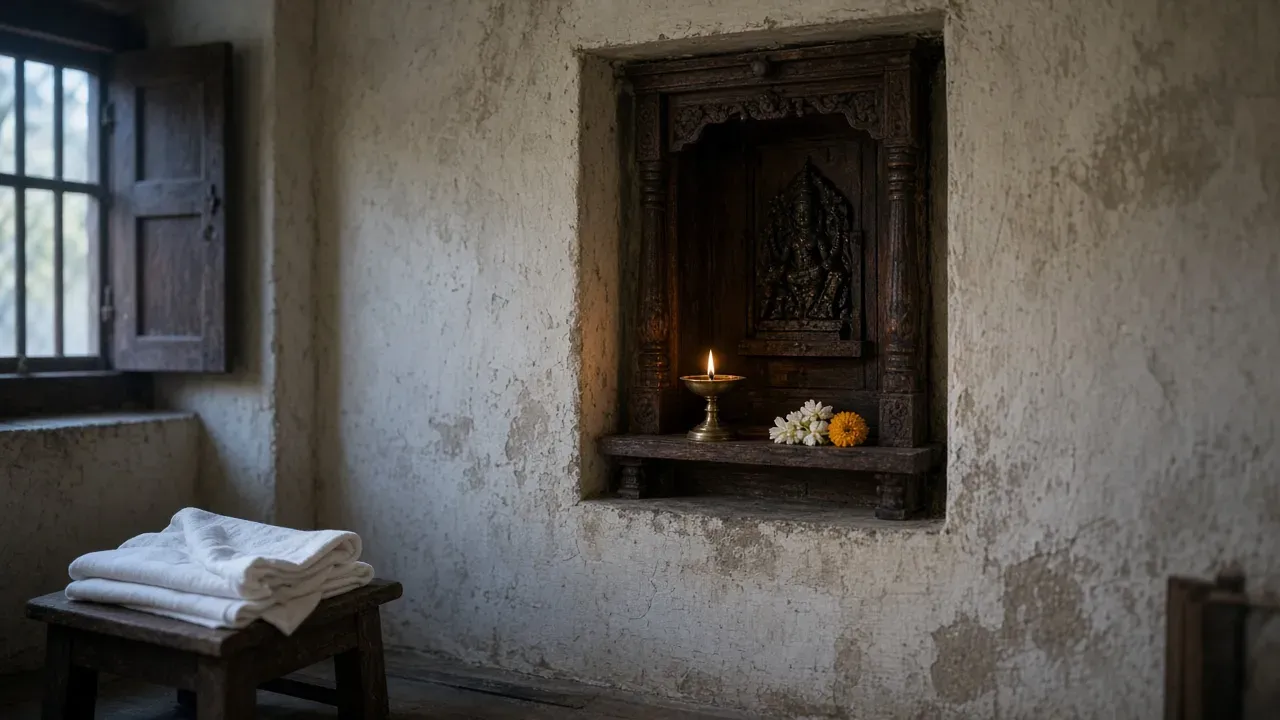
Many such incidents came and went in life after that. Many difficult circumstances arose and passed. As long as her health permitted, I would go to her and tell her, “This has happened, and I cannot find a way forward.” She would say, “Go to the temple at home and pray. I will pray too.” And she would perform religious rituals and prayers (Anusthan).
Sometimes, I would learn much later that a particular ritual (Anusthan) she had performed was for that very problem. Most of the time, however, I never found out. We eventually stopped asking, too, because we knew that if she wanted to tell us, she would.
She did not perform these rituals (Anusthan) only for us. She did them for anyone. If someone simply told her that they were going through a difficult time and asked her to pray for them, she would do so, even undertaking religious observances and rituals (Anusthan). Perhaps people, too, had faith that her prayers would bear fruit.
She was not highly educated. Perhaps she had studied up to the eleventh standard, as it was called in those days. Like every human being, she had her limitations. I feel that she was more suited to a spiritual life than to the practical demands of the material world.
But at her core, she was someone who felt the pain of others as her own. Poverty played a significant role in shaping the person she became. A considerable part of her life had been spent in deprivation, yet she never developed the inclination to deceive others. She tried to instil in us the fundamental values of human life. I remember once she once told us to read adhyaya 15 (purushottam yoga) from Geeta, when earthquak took many lives.
And today, as I write all this, those incidents, difficulties, pain, struggles, poverty, her unwavering faith in God, her unshakeable trust in us, and her willingness to take upon herself the troubles of others — her entire life is passing before my eyes.
What should I write, and what should I leave unwritten?
Sane Guruji was right. Writing about a mother is incredibly difficult. For anyone, writing about their own mother is difficult.
That mother is no longer with us. She is no longer physically present. In the early hours of 15 October 2026, she breathed her last, and we were left bereft.
Now, there will be only her experiences and memories, which will remain with us for as long as we do not forget them.
Essence
If I have developed even a little inclination towards reading, my father deserves some of the credit. But if I am able to write stories, even to some extent, the entire credit for that art and imagination goes to my mother. She was a wonderful storyteller, blessed with an extraordinary imagination.
A Gem of Wisdom
Once, some guests arrived at our home when we did not have even a single rupee. My father was away on a work trip. When guests came over, we had to offer them something to eat. The only thing we had at home was potatoes.
My mother made a dry potato curry and even prepared halwa using potatoes, and served them buttermilk alongside. The guests kept eating and praising the food, completely unaware that everything they were eating had been made from potatoes alone.
We children kept looking at one another, feeling terribly embarrassed inside, worried that the secret would be exposed at any moment. But somehow, the occasion passed off smoothly.
The incident remained a running joke for a long time afterwards: “It’s a good thing we had potatoes and not cluster beans (guvar), otherwise Mother would have made a curry out of guvar and even halwa from it!”. After all, in times of poverty, what other sources of entertainment did we have apart from humour!
Thus said Dinesh Gajjar
Published at 11:00 pm, Mon Oct 19th 2026 from Ahmedabad, Gujarat, India.