Art of Story Telling
Once Upon a Time, There Was a Kitten...
Once upon a time, a little kitten came near a grapevine. It was hungry, so it thought it could jump up and pluck a bunch of grapes. But the kitten was small in size. It tried jumping several times but could not reach the grapes. So, just like the fox in the familiar story, it said that the grapes were sour and walked away. Did it walk away?
No. It thought that the fox had simply stopped trying. Surely, there must be another way to find a solution! So, the kitten began collecting small stones lying around and made a pile out of them. It climbed onto the pile and jumped. It thought that now it would be able to reach the bunch of grapes, grab it, pluck it and bring it down. But something else happened. It jumped higher than before from the pile of stones, yet it still could not reach the bunch of grapes and fell down. It tried again, but could not reach them. What should it do now?
Once again, an idea came to its mind. Instead of jumping, why not find a branch, climb onto the pile of stones and extend the branch to reach the grapes? That way, it might be able to bring the bunch down. So, it started looking for a branch and found a nice one that it could lift by itself. It held the branch in its mouth, climbed onto the pile of small stones and tried to reach the bunch of grapes with the branch. After two or three attempts, a beautiful bunch of grapes got caught in the branch and, as it pulled, the bunch fell to the ground. Now what? Did the kitten eat the grapes?
No, because they had fallen into the dust! They had become dusty, so they needed to be cleaned first. The kitten then picked up the bunch of grapes, carried it to the nearby riverbank and washed it in the water. It then put the first grape into its mouth.
Ahhhhh… What grapes they were! So sweet, so soft and so delicious that the experience would remain etched in its memory for a lifetime. What wonderful grapes they were!
Seeing the expression on the kitten’s face, its delight in the taste and the satisfied burp that followed, the other kittens standing nearby became excited too. They rushed over and said that they wanted to eat grapes as well.
The kitten replied, “Come on, let’s all pluck the grapes, wash them and eat them together.”
So, all of them returned to the grapevine. The first kitten now knew how to get the grapes down, but this time there were more mouths to feed. What could they do now? They could not go to different spots and pluck grapes using just one branch. Nor could they keep building piles of stones everywhere.
So, the kitten told the others, “Let’s build a kitten tower (a pyramid) together. The one at the top can pluck the grapes and throw them down.”
All the kittens formed a circle. They climbed on top of it and formed another circle. Continuing in this way, they managed to reach the bunches of grapes. They plucked many bunches and threw them down to the ground.
And then? They all went back to the riverbank, washed the grapes in the water and ate them. They had such a wonderful time that words cannot describe it!
After that, they returned to the grapevine and lay down in its shade. They had worked hard and enjoyed a lovely meal, so they felt wonderfully sleepy. Before long, all of them were fast asleep.
The grapevine noticed that the sunlight had started falling directly on the little kittens. What if the sunlight disturbed their sleep? So, the grapevine spread out its branches with their many leaves and positioned them in such a way that they blocked the sun. The sunlight stopped falling on the kittens, allowing them to sleep peacefully and undisturbed throughout the afternoon.
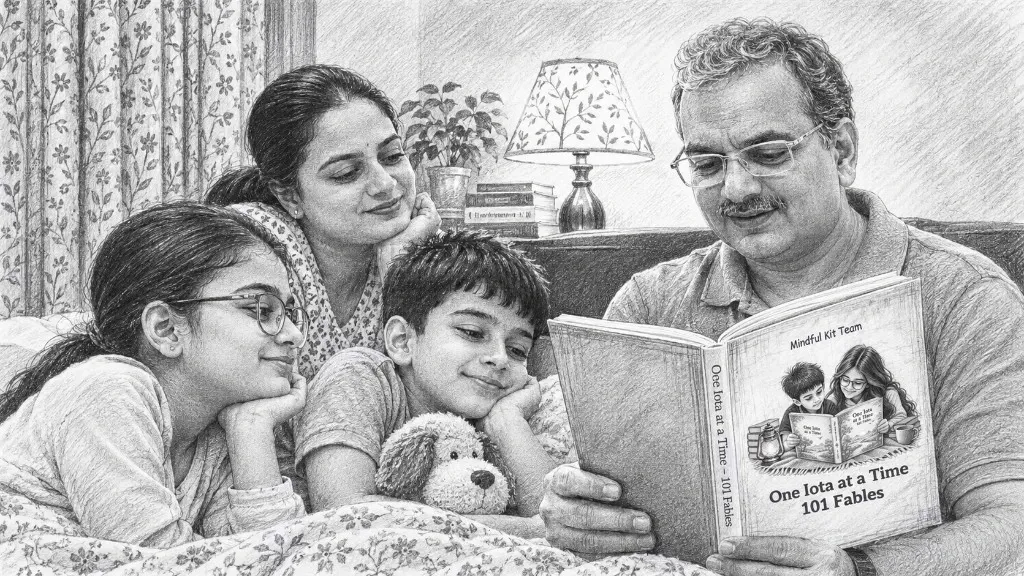
I narrated this story to my children as a bedtime story on the night of 5 November 2026, while putting them to sleep.
Some may find this story original, while others may feel that they have read it somewhere before. However, this story was inspired by the old fable of the fox and the grapes. I took that story forward, developing it in a way through an ongoing interaction with my children. As I narrated it, I kept weaving into the story what I wanted them to understand—the thought behind the story.
It is not that I tell them a story every night. Sometimes, when they create a lot of mischief during the day, I tell them, “I had kept a story on that table, but seeing all your mischief, it got scared and ran away.”
Many times, I get late reaching home, and the child is waiting for me to hear a story. But if I am tired, I tell them, “I couldn’t find a long story today. Perhaps if we recite this shloka for two minutes, we might find a short story.”
And then I narrate a small story.
Whatever I observe in the children’s behaviour throughout the day, I weave into a story in a way that makes it enjoyable. And we should not turn storytelling into a series of lectures or sermons. Children love stories. And why only children? Adults love stories too. That is why we see so many storytellers and traditional narrators around us.
If someone simply says that a person should behave while keeping the principle of karma in mind, it remains just a sentence. People will listen and forget it. But if you weave the same thought into a story, people will understand it immediately and remember it as well.
Whether they put it into practice or not is up to the individual. But through the story, they at least come to understand what is right and what is wrong. Choosing whether to follow it is the next step.
One thing is very important in life: a lesson must remain in our memory. Because if we remember it, that learning will come in handy when we have to make decisions.
So, the question is: if someone wants to tell a story, present it effectively and communicate a particular thought through it, where can they learn the art of storytelling?
There are three important qualities required to become a storyteller:
- Reading (or observing and having the art of listening).
- Practising the art of storytelling.
- Imagination. It is perfectly fine if a person does not enjoy reading, as long as they know how to observe. And if they are not good at observing, they should at least have the ability to listen to others.
This is because each of these activities can provide a seed for a story.
You may have read something, listened to someone’s narration, observed a person or an incident, or, in today’s context, watched a movie, a play, a series or even a reel. Any of these can provide you with the subject matter for a story.
How you develop this seed further depends on your imagination, which is the second quality. Because taking that seed forward in your own way depends on your thinking and imaginative abilities.
Someone might ask, “Can a story not be developed without imagination?” The answer to this question will come later.
A person may have a wonderful story, but if they do not know the art of telling it, if they stumble while narrating, feel nervous or are simply unable to speak, the story will never reach the listener.
To tell a story, a person has to practise. This is the third important quality. Through practice, a person can become a good storyteller.
Many people say, “I have so many wonderful stories, but I cannot narrate them the way you do.”
But what I want to say is: why do you have to tell stories like me? You should tell stories in your own way. Follow, but do not imitate. The art of storytelling develops through practice. A person simply needs to have an interest in it. After all, nobody is born a storyteller.
If someone possesses all three of these qualities, can they become an excellent storyteller? Yes, they can. But there is still one more important quality needed to become an effective storyteller.
Fundamentally, this quality is more important than all the others. It is even more important than the three qualities mentioned above—reading, imagination and practice.
And that is telling a story from the heart.
Whatever you wish to communicate, say it wholeheartedly. Stories told with your emotions and sensitivity woven into them have proven to be effective.
There are times when a storyteller may not possess even one of the qualities mentioned above, yet a story told from the heart can still leave a lasting impression.
It has often (in fact, most of the time) been observed that a storyteller possessing all three qualities—reading, imagination and practice—may narrate a very powerful story, yet it fails to reach people. The reason is that the storyteller has not been able to touch the hearts of the audience.
If you look around, you will find plenty of examples. Until you touch the heart of the listener, everything else is meaningless. And I would place this quality above all the others.
Because knowledge, practice and imagination may not always be present. But if a story is told with genuine emotion, from the heart, it will remain etched in the listener’s mind.
In earlier times, when a mother narrated stories to her children, she did not know about any of these qualities or techniques. She knew only one thing: these are my children, and I need to tell them stories so that good values can be instilled in them.
She simply devoted her time, thoughts and emotions entirely to telling those stories.
Stories narrated from the heart stay with children for years.
You will notice that stories told from the heart—and even films, plays, discourses, novels, short stories and lessons taught in classrooms—remain in a person’s mind for a long time.
Many people confuse this quality of telling stories wholeheartedly (with sensitivity) with the ability to narrate stories dramatically. But they are not the same thing. This distinction is worth remembering.
Thus, stories told with knowledge, practice, imagination and heartfelt emotion are bound to reach the listener, whether that listener is an adult or a young child.
This article is based on my personal experiences. It is not necessary that this is the only way to become an effective storyteller. Others may have different experiences, and they may not agree with the thoughts expressed here. But this is my current perspective, shaped and tested through my own experiences.
Essence
Some stories make us laugh, some make us think, while others stay with us for a long time.
Perhaps that is why books hold such a special place in our lives. Every book seems to open the door to a new world, through which we can see, understand and experience something new.
A small collection of such thoughts and stories…
One Iota At a Time: 101 Fables.
Because some stories are not merely meant to be read; they are meant to be carried with us through life.
A Gem of Wisdom
“After nourishment, shelter, and companionship, stories are the thing we need most in the world.”
— Philip Pullman
Thus said Dinesh Gajjar
Published at 7:53 pm, Sun Nov 8th 2026 from Ahmedabad, Gujarat, India.